
In this guide
Start with the amount of fragrance you want to sell. If the finished pack calls for 150 mL, ask the glass supplier where 150 mL sits in each bottle and whether the intended shipping plug fits above it. A bottle described as “150 mL” could be referring to the fill line, the brim or a catalog size.
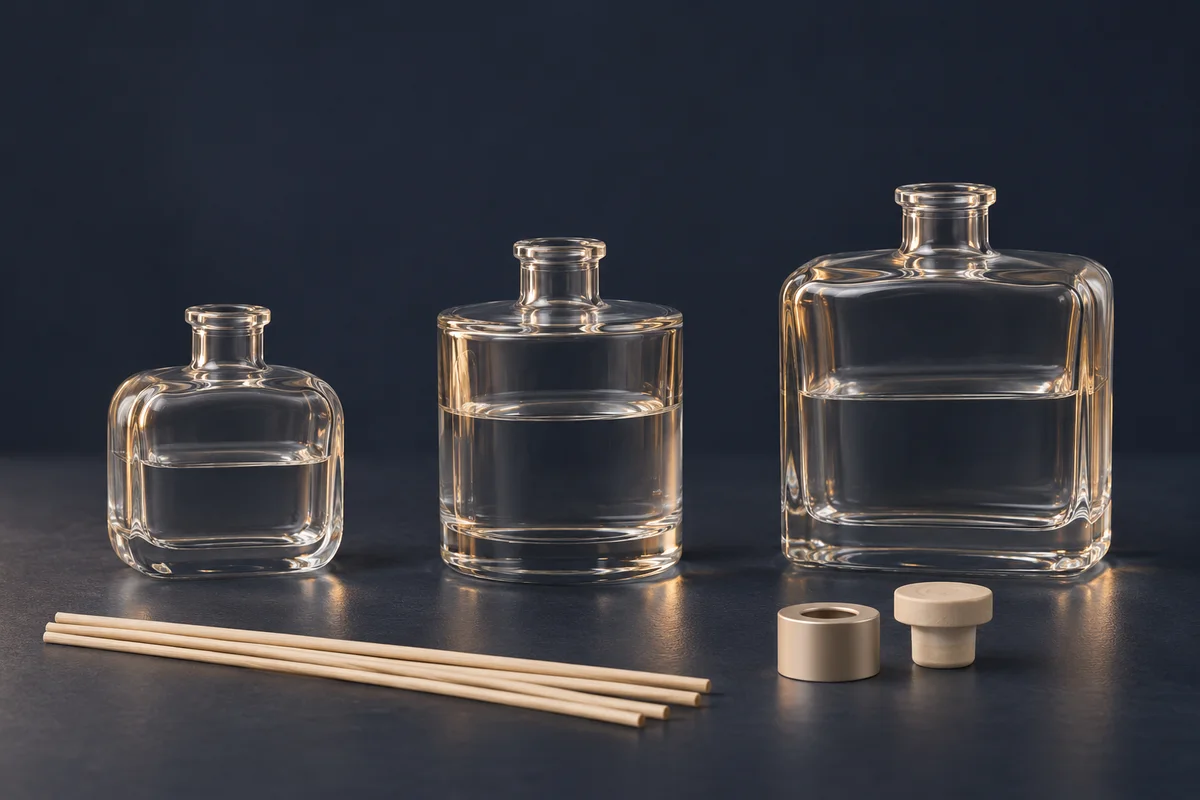
What does the bottle’s capacity mean?
| Term | What it describes | What to ask for |
|---|---|---|
| Brimful or overflow capacity | The volume of the open bottle filled to the brim. | The capacity in mL, how it was measured and the tolerance. |
| Target fill volume | The amount of fragrance planned for each finished unit. | The height of the liquid at that volume, measured from the base. |
| Headspace | The space above the liquid. A plug or other part inserted into the neck can occupy some of that space. | A check with the actual liquid, plug and packed configuration. |
Check the units on the product sheet. For example, CandleScience’s round bottle listing gives a fill-line weight of 165 g and an overflow volume of 184 mL. If your filler measures by weight, use the density of the intended fragrance blend at the agreed temperature to relate grams to millilitres. A water trial can help locate a fill line during sampling.
Start with 100, 150 or 200 mL?
Treat these sizes as possible fill targets. For a 100 mL set, begin with the shelf or gift-box footprint. At 150 mL, compare a shorter, wider form with a taller one at the same fill. For a 200 mL range, check the filled pack weight and the box dimensions before you price delivery. The available bottle shapes will determine which comparisons are useful.
Check the front view at the intended fill. In a narrow body, a small change in volume can move the liquid line more visibly than in a wide body. If you are ordering clear glass with a printed logo, mark where the liquid should sit relative to the artwork on the signed sample. Ask for outside measurements to plan the box and a neck drawing to check the closure fit.
Compare two bottles for a 150 mL fill
Illustrative comparison
Suppose two open samples have measured overflow capacities of 172 mL and 165 mL. At a target fill of 150 mL, the difference between fill and overflow is 22 mL in sample A and 15 mL in sample B.
Those figures help you decide what to sample. For either bottle, check the clearance with the shipping plug fitted, the filler’s expected variation and the way the unit will be packed. Record the approved fill height and closure together.
For a 150 mL project using JUNOVA’s JN-DB001, start from its published approximate capacity of 180 mL. Ask how that figure was measured and request a check at your intended fill. That catalog figure alone cannot establish the packed headspace or confirm plug fit.
What to measure on the sample
- Record the bottle reference, drawing revision and measured overflow capacity. Check the supplier’s stated tolerance and agree how variation will be assessed.
- Ask the filler to bring the bottle to the target volume with the intended liquid. On a level surface, note the fill height from the base and take a straight-on photo beside a ruler. Review the filled look with the artwork in position.
- Fit the specified plug and cap. Review clearance and ask the supplier and filler to agree how they will check closure fit and leakage for the planned shipping configuration. See the guide to plugs, caps and collars for which parts to record.
- Set up the bottle for display with the chosen reeds. Check that they reach the intended liquid depth and fit the opening. Use the reed length guide to compare display height and packed length separately.
Send the same brief to each supplier
We need an empty glass diffuser bottle for a 150 mL fragrance fill. Please provide the proposed bottle reference, measured overflow capacity and tolerance, expected fill height from the base, and a dimensioned neck drawing. Quote the glass, matching plug and collar, decoration and retail pack separately. We would like to check the bottle and shipping plug together before approving production.
Attach the artwork, available box dimensions, quantity by finish and delivery destination. If the bottle and refill ship separately, specify the amount in each unit with the refill packaging guide. When the filling team signs off, keep its notes with the approved sample record.
Questions buyers ask
Can I estimate fill volume from the outer dimensions?
Use outside measurements for shelf and box fit. The wall thickness, base and shoulder change the internal volume, so use a capacity drawing or a physical sample for filling.
Will a larger bottle make the fragrance last longer?
Evaluate the actual fill, fragrance blend, reeds and display conditions together. The catalog capacity alone cannot tell you how long a diffuser will last.
Once you have a fill target, compare square and round bottle forms for the label, box insert and display orientation.
Compare JUNOVA diffuser bottle forms
Choose a reference and send your target fill, closure requirements and dimensions. The custom bottle buyer guide shows what to include for decoration, quantities and packing.
Browse glass diffuser bottles