In this guide
The minimum order for a custom candle jar depends on the work involved: decorating an existing form, changing its finish or developing a new shape. Ask for the minimum per size, colour and artwork. Compare the complete jar-and-lid price, with setup, sampling and tooling shown separately.
For a first collection, price the branding you need on an existing form. Review a new mold if the required shape or fitting cannot be achieved that way. This guide covers empty glass vessels; a filled private-label candle needs a separate quotation scope.
Choose between an existing form and a new mold
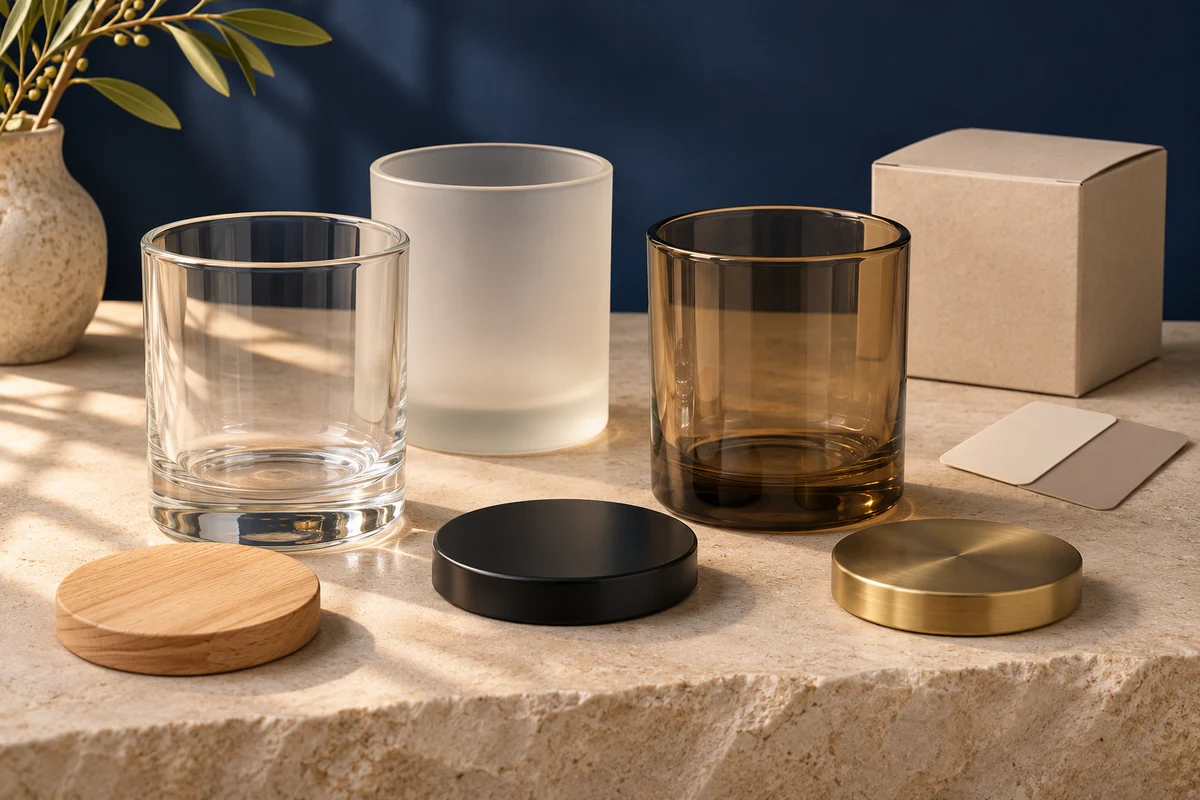
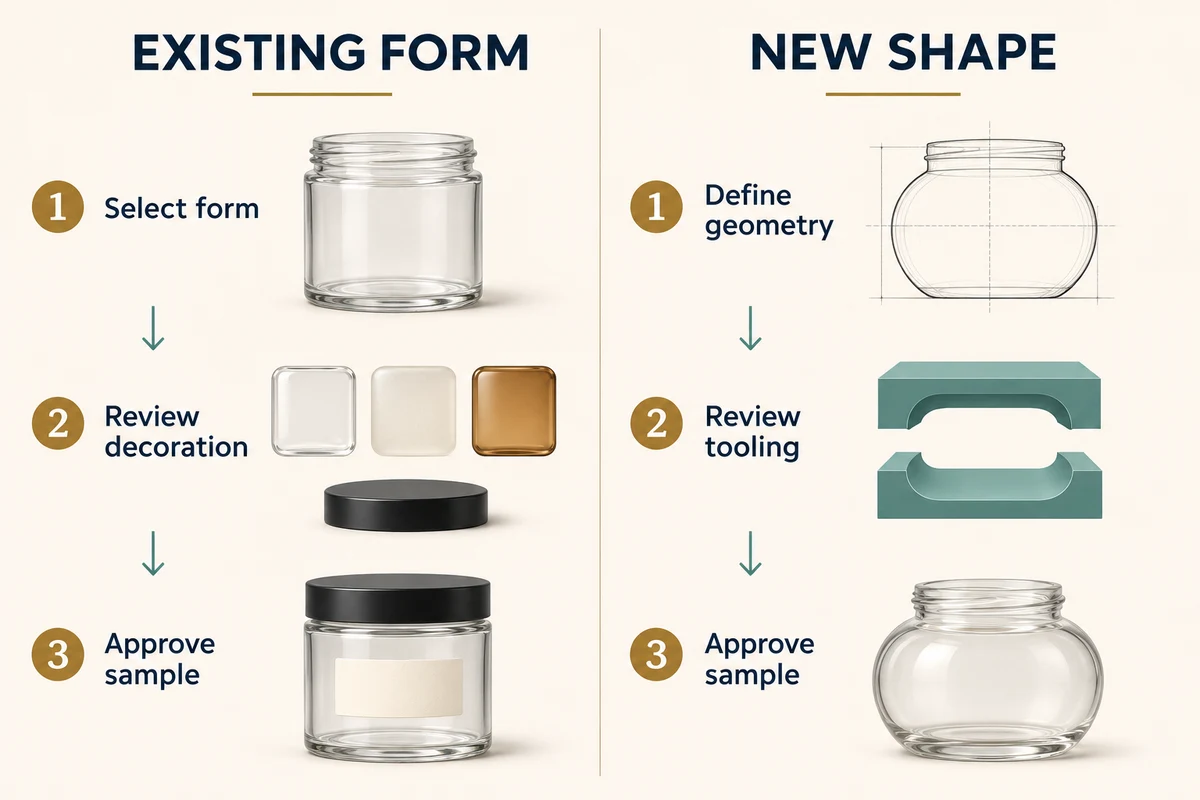
A printed logo on an available jar usually starts with a decoration review. Changing the opening, body profile or a fitting requires a glass-development review, even if the jar looks similar.
| Route | What stays or changes | What to ask before comparing price |
|---|---|---|
| Existing form with a label or artwork | The selected glass geometry remains the starting point; the branding is specified for its usable surface. | Which form and finish are available? Does the offer include labels, application or printing, and which artwork setup? |
| Existing form with a different finish or lid | The body reference may stay, while the surface process or accessory set changes. | Which operations have their own minimums? Are the jar, lid and any insert matched on the proposed sample? |
| New glass shape or interface | The finished geometry must be reviewed against drawings and the proposed manufacturing route. | What tooling and sample stages are needed? Which charges are one-time, and what order quantity is being quoted? |
An existing catalogue form may still need production. Ask about availability for your size and finish. If you have only a photograph, use the candle jar buying guide to define dimensions, fill and accessories before requesting a quote.
Check the minimum per configuration
Ask what each minimum applies to: plain glass, one colour, one artwork run or the complete packed unit. A total order quantity can hide several smaller runs.
For example, 600 jars split across three colours gives 200 per colour. Add two printed designs per colour and each artwork run falls to 100. Ask whether the supplier accepts that split and which operation sets the minimum.
- Per glass form or size: can different vessel sizes share the minimum?
- Per colour or finish: does each surface process require a separate run?
- Per artwork: do different logos, fragrance names or print colours create separate setups?
- Per accessory or pack: do the lid and retail box have different ordering units?
The distinction appears in public packaging services. For example, Stocksmetic’s customization page lists 200 pieces for one-colour screen printing and 500 for two-colour printing. These are that service’s published conditions, not a universal candle-jar minimum or a JUNOVA offer. Check the current terms for the chosen container and process.
JUNOVA’s candle jar collection lists a reference MOQ starting at 100 pieces for its featured series, depending on size, finish, lid and packaging. Decoration and new molds need their own minimums confirmed against the full quantity breakdown.
Separate unit prices from setup charges
Compare the same supplied unit. A glass-body price excludes items that a packed jar may include, such as a decorated lid, insert and gift box. Separate recurring unit charges from setup and sampling.
| Cost line | What the quotation should identify | Useful clarification |
|---|---|---|
| Glass vessel | Form, size, glass/finish description and quantity. | Is the price for undecorated glass or the finished surface? |
| Lid and fitted parts | Material, reference, liner or insert if included. | Is the accessory supplied and reviewed with this jar? |
| Decoration | Artwork version, process, coverage and print colours. | Which operations are included, and which are separately quoted? |
| Artwork, sampling and tooling | Each setup or development charge and the scope it covers. | What repeats on a reorder or after a design change? |
| Retail and transport packing | Box, insert, unit protection, carton quantity and outer dimensions. | Does the price include the complete selected pack? |
| Delivery scope | Currency, destination, stated delivery basis and quote validity. | Which freight, tax or destination charges remain outside the quote? |
State where the logo goes: on the glass, a label or the lid. Include the visible logo size and label outline so the decoration quote covers the intended work.
Compare first-order subtotals
Use the same currency and scope for both proposals: project subtotal = unit price × quantity + included one-time charges. Add any excluded costs before choosing a supplier.
Illustrative arithmetic — not a supplier quotation
Assume two fictional proposals cover the same approved jar, lid and decoration, and both permit the quantities shown. Proposal A has a unit price of US$1.70 and a one-time charge of US$180. Proposal B has a unit price of US$1.55 and a one-time charge of US$400. Freight, taxes and any other excluded services are outside this example.
| Quantity | Proposal A | Proposal B |
|---|---|---|
| 1,000 units | 1,000 × $1.70 + $180 = $1,880 | 1,000 × $1.55 + $400 = $1,950 |
| 2,000 units | 2,000 × $1.70 + $180 = $3,580 | 2,000 × $1.55 + $400 = $3,500 |
At 1,000 units, Proposal B costs more despite its lower unit price. At 2,000 units, it costs less. These fictional figures show how quantity changes the subtotal; they are not market prices or a JUNOVA quotation.
For a reorder, ask which setup charges fall away. New artwork, a changed lid or replacement tooling may add costs. Keep the quotation revision with the approved sample and drawing record.
When a new shape needs development
Review a new shape when an existing form cannot meet a required profile or component interface. For a change in appearance, compare decoration and lid options first.
Agree tooling ownership, maintenance, permitted use, design rights and the cost of later changes. A tooling payment alone does not establish exclusivity; that needs written commercial terms.
Public suppliers also separate these scopes. Glassnow’s customization overview, for example, describes decoration and fully custom container design as distinct services, with product-dependent options. Use that distinction to frame your questions; another company’s minimums or development terms do not transfer to JUNOVA.
Plan a smaller first order
Start with one glass form. Mark the features essential for launch and request alternatives separately. This makes quotations easier to compare, although the MOQ and price still depend on the selected configuration.
- Choose the starting vessel and identify the dimensions or fill target that matter.
- Separate the required finish from an optional alternative; do the same for the lid.
- Provide one artwork revision and state how many distinct designs are needed.
- Give the exact quantity by size, colour and design instead of one combined total.
- State whether you need glass only, a complete empty packaging set or additional services to be quoted separately.
- Confirm the sample scope before production. A styled image is not an approved fit, finish or filled-candle result.
Use the glass colour and coating comparison to describe the finish and the lid material guide for closure choices. The responsible development and filling partners still need to evaluate the finished candle.
A brief to send with your quote request
A brief you can adapt
“We are sourcing empty glass candle jars for a branded collection. Please quote the selected existing form with our proposed finish and logo, and identify whether a new-shape review is needed for the attached profile. Our quantity breakdown is attached by size, colour and artwork. Include the named lid and retail pack as separate lines. Please state the MOQ basis, sample stages, one-time charges, reorder conditions, delivery scope and unresolved specifications.”
Attach the drawing or product reference, artwork, finish, accessories and destination. Include your required delivery date so the supplier can review the sample approvals and production schedule.
Compare the cylindrical jar and tinted jar series, or browse all candle jar references. Send the selected configuration through custom glass development for review.
Questions buyers ask
Can I order custom candle jars with a low MOQ?
Possibly, depending on the chosen form, finish, decoration, lid and packaging. Ask for the minimum per configuration and per operation. An available form with a particular decoration route may suit a smaller launch than new glass development, but the exact proposal needs confirmation.
Can several fragrances share one glass jar order?
Ask separately about the glass quantity and the artwork or label runs. The same undecorated glass may be used across a range, while different printed designs can have separate minimums. Fragrance filling is a separate scope from supplying empty glass.
Does a custom candle jar quote include wax and fragrance?
Only when filling and the complete finished candle are explicitly included. An empty jar or empty packaging-set price does not automatically include wax, wick, fragrance, formulation development or finished-product evaluation.
Should I choose the lowest price per jar?
Compare the complete supplied unit, one-time charges, accepted quantity, sample approval and delivery scope. A lower unit-price line can have a higher first-order subtotal or omit parts another proposal includes.
Is a new mold necessary for my logo?
Not automatically. Ask whether the proposed artwork can be applied to the selected existing form or accessory. A logo built into the glass geometry is a different development request from a printed or applied mark.
Choose a jar reference
Choose a jar reference and send the quantity by size, colour and artwork, with the lid, packaging and destination. JUNOVA can then review the configuration and identify any drawing, sample or partner checks needed.