
In this guide
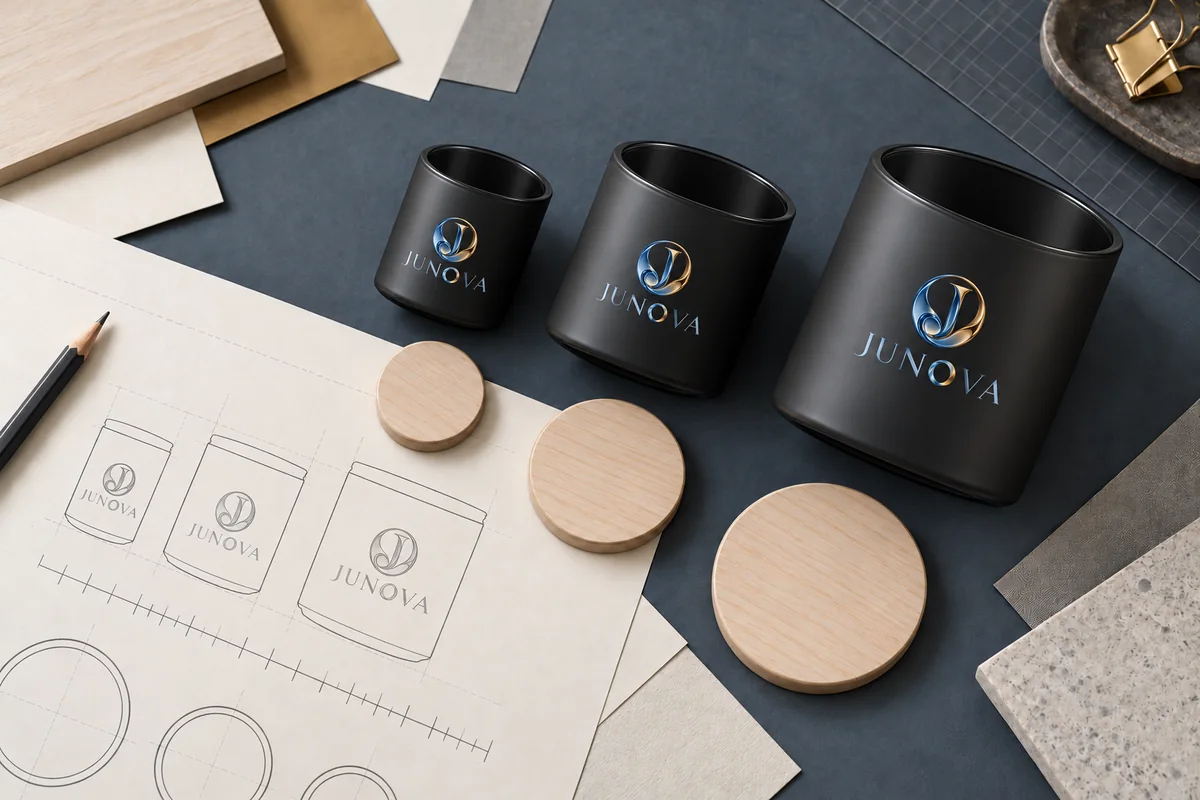
For a candle collection with several jar sizes, decide what should stay consistent before choosing the candle jar logo size. Keep one physical logo width if you want the mark itself to remain the same size. Use a proportional starting point if you want the mark to change with the vessel. Neither approach removes the need to review each finished layout at actual size.
JUNOVA Glass's JN-CJ001 cylindrical glass candle jars with lids provide a useful three-size example. This guide compares the two artwork decisions using the published reference dimensions. It does not calculate a printable area or prescribe a logo width for the product.
In this guide
Is logo size the same as candle label size?
No. The logo is one element within the artwork; the label outline defines the complete applied piece. You can hold the mark at one visible size across a range while changing the label outline and text layout for each jar.
Review an actual-size proof on each selected jar. Compare the viewing position and the space around the mark, then ask the decorator or printer to confirm the process-specific fine-line and text requirements. The numerical comparison below illustrates visual scale; it is not a print-process minimum.
Should a candle jar logo stay fixed or scale with the jar?
A fixed-width mark gives the designer one physical logo size to carry through the range. The smaller jar will devote more of its face to that mark; the larger jar leaves more surrounding space. That can be an intentional collection rule rather than a mismatch.
A proportional rule changes the logo with an identified vessel dimension. Name that dimension: outside diameter and overall height are different choices. A range whose diameter and height change by different ratios cannot be matched in both directions by one scale factor.
Start with the size that represents the collection best, then place the other jars beside it. Choose the visual relationship you want to preserve. Avoid an instruction such as “make every logo 80%” without identifying the master artwork, its physical dimensions and the dimension used to scale it.
How does one logo compare across three jar sizes?
The current JN-CJ001 page lists reference diameter × height options of 7 × 8.4 cm, 8 × 9 cm and 9 × 10 cm, with wood, bamboo and metal lid options subject to the selected specification. The table converts those reference dimensions to millimetres so the units match the artwork example.
| Reference diameter × height | Fixed logo width | Width scaled by diameter |
|---|---|---|
| 70 × 84 mm | 20 mm | 17.5 mm |
| 80 × 90 mm — example master | 20 mm | 20 mm |
| 90 × 100 mm | 20 mm | 22.5 mm |
Here the designer invents a 20 mm master logo width for the 80 mm reference. For the proportional column, the chosen rule is: new logo width = 20 mm × new reference diameter ÷ 80 mm. Thus the 70 mm reference gives 17.5 mm and the 90 mm reference gives 22.5 mm.
This diameter ratio is a design starting point. It is not a calculation of printable circumference, label width or the apparent width of a mark viewed on curved glass. It also does not scale the full height of the jar. Request the selected sample and decoration template before turning either column into production artwork.

How do you review logo size and reading copy separately?
Do not resize the complete front design automatically just because you selected a logo rule. A scent name, brand name and small secondary copy can need different treatment from a simple symbol. Compare actual-size proofs for all three jars, both individually and together. Identify any wording that must be rearranged instead of reduced.
As a relevant supplier example, London Luxury Candle Supplies' printing guidance asks customers to review artwork placement, scale, proportions and whether the correct design is applied to the correct product. It also distinguishes an AI visual mock-up from an exact print proof. Those are useful review points, not evidence that its process or print capabilities apply to a JUNOVA Glass jar.
Keep the logo's width separate from its position. An agreed width still needs an identified reference for vertical placement and viewing direction. Review a lid mark separately on the selected lid rather than carrying the jar-body scale factor over to it. If a paper label is part of the design, use the label-panel measurement guide for its outline and the printer's template for its artwork margins.
What belongs in each candle jar artwork record?
Give each jar-size and finish combination its own artwork reference, even when the logo width is shared. Record the master file revision, fixed or proportional choice, final logo width and height, position reference and proof revision. Leave the final decoration area and any process limits for confirmation with the selected decoration partner.
Download the blank three-size artwork decision sheet (CSV). It includes the published body reference sizes but leaves logo dimensions and decisions blank. The example 20 mm width is deliberately not prefilled as an approved specification.
Carry the chosen artwork into the identified sample approval record. For component matching, use the separate wooden-lid fit guide. Browse candle and fragrance glass, or discuss your chosen JN-CJ001 size, finish and branding direction through custom glass development.
Artwork quantity and print colours can change the quotation basis. The candle jar MOQ and quote comparison shows how to request minimums by configuration rather than only by total order.
Continue your candle packaging brief
For a project enquiry, send the selected jar, target fill, lid, finish, quantity and destination.
Compare glass candle jars