
In this guide
Borosilicate glass is used in tea kettles, storage containers, laboratory glassware and selected lighting components. Its low thermal expansion is useful when a part heats and cools in service. For a curved glass component, the next question is how to get the shape. A supplier can assess whether a section cut from existing tube stock matches the drawing or whether a flat sheet needs to be formed over a mold.
What should you send for a curved glass feasibility review?
Send the finished cross-section, part length, thickness, edge requirements and the surfaces that must mate with other parts. State whether the curve is described by a radius, a straight-line chord or an arc length; those dimensions cannot be substituted for one another.
If heat behaviour is part of the brief, request the actual glass grade and project-specific review. The material discussion here does not identify the composition of every JUNOVA product. For lighting parts, link the drawing to the actual mounting interface and the complete glass shade brief.
What is borosilicate glass?
Borosilicate is a family of glasses made with silica and boron oxide. Low-expansion grades change size relatively little as they heat up. When one area of a glass part heats faster than another, less expansion helps limit the stress created by that temperature difference. Glass composition, wall thickness, edge condition and mounting still matter when evaluating the finished part. Ask for the specific grade if the application depends on thermal performance. SCHOTT’s borosilicate glass overview
Where is it used?
Candle jars, holders and hurricane sleeves. A filled jar holds the wax and wick. A holder supports a separate candle, and a hurricane sleeve surrounds a candle on a separate base. Each arrangement exposes the glass to heat in a different way. Start by identifying which role the glass plays in your design. Candle jars, votive holders and hurricane glass
The JUNOVA Glass JN-CJ002 tinted candle jar series is a useful example for a candle brand reviewing color, finish and lid options. The catalogue shows smoke-gray and amber jars with separate metal lids and lists three reference sizes. Use the series as a design reference. If the brief calls for borosilicate, request written confirmation of the glass grade for the selected jar and sample. Review appearance with the chosen finish and lid, then evaluate the proposed filled candle with its actual wax and wick. Keep the approved material and sample reference on the same record.
Tea kettles and storage containers. The glass body and the accessories can have different conditions of use. Kavalierglass, for example, identifies its SIMAX Svatava tea kettle as borosilicate and specifies a flame diffuser for gas-stove use. The same manufacturer gives glass-only heating instructions for a storage set supplied with plastic lids. Review the instructions for the complete set you intend to sell. SIMAX Svatava kettle · SIMAX storage dish set
Laboratory equipment, lighting and industrial windows. Borosilicate tubing and sheet serve different roles. Drawn tubing is a starting form for products such as laboratory glassware and some lighting components. Sheet grades are used in applications including inspection windows and protective covers for lighting equipment. For a shade or cover, identify the heat source and how the glass is mounted. SCHOTT glass forming · BOROFLOAT applications
Two ways to make a curved glass part
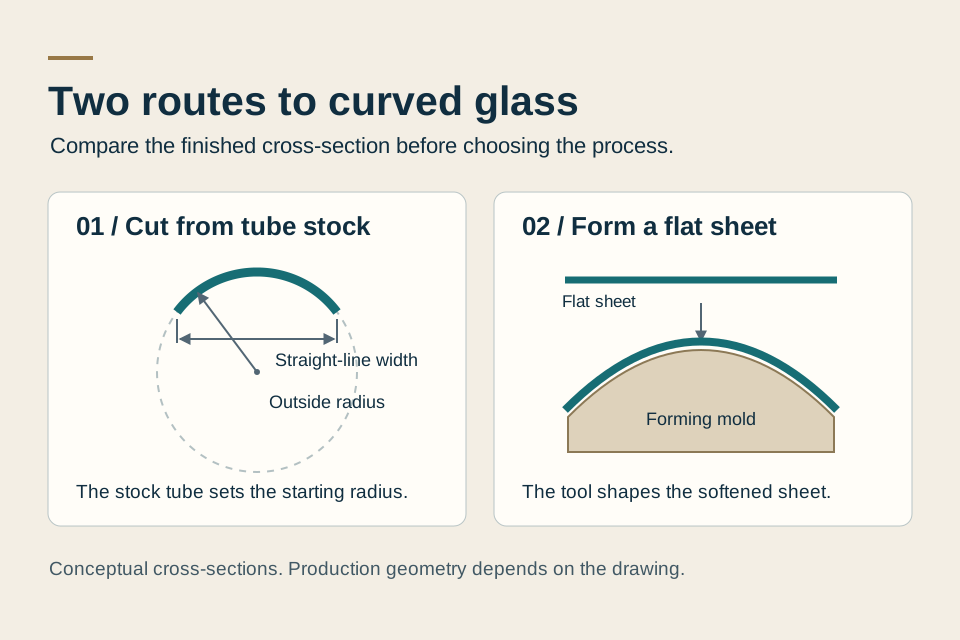
Cut a curved section from a tube
If the panel follows a constant circular arc, ask whether a suitable borosilicate tube is available. The tube’s outside diameter sets the starting outside radius. For an open panel, a processor can assess cutting along the tube’s length to remove a section, then trimming and finishing its edges to the drawing. Show the angle or width of the section you need. A half cylinder is one possible shape. Tube availability, wall thickness, part length and the specified edge finish all affect feasibility. Schröder Spezialglas on custom tube machining
Heat-form a flat sheet over a mold
Start with flat sheet when the desired profile calls for a radius or transition that available tube stock cannot supply. In hot bending, the sheet softens in a furnace and takes its shape against a mold or tool. Hot slumping is one version of this process. Agree on the finished profile, the surfaces that need cosmetic inspection and the edge work after forming. A study on thin borosilicate sheets documents hot slumping over a mold for a specific optical application. The feasible geometry for a homeware or lighting part depends on its glass grade, thickness and tooling. Proserpio et al., hot-slumping study
| Detail to put on the drawing | Section cut from tube stock | Heat-formed sheet |
|---|---|---|
| Curve | Outside or inside radius, straight-line width across the opening and part length | Finished cross-section with radius, width and any straight sections or transitions |
| Edges | Finish on the two long cut edges and the ends | Finish on exposed edges and any areas to be trimmed after forming |
| Sample check | Arc fits the base or rails along the part’s length | Profile matches the drawing, mating points sit correctly and visible surfaces meet the agreed appearance |
Drawing example. A nominal 120 mm outside-diameter tube starts with a 60 mm outside radius. On a panel cut from that tube, a 100 mm straight-line width measured between the outside edges gives an arc depth of about 27 mm at the center, measured from that straight line. A 100 mm measurement taken along the curved surface gives a different panel. Label the straight-line width, outside radius and arc depth directly on the cross-section. These dimensions illustrate the geometry of an ideal circle.
What affects the cost?
For a tube-based part, check whether the diameter and wall thickness are available as stock. Ask which cuts, fixtures and edge finishes the estimate includes. A sheet-based proposal may include a forming mold, a trial run, furnace time, controlled cooling and trimming. Ask which setup or tooling charges are one-time and which operations recur in each batch. Compare proposals against the same order quantity, finished tolerances and acceptance criteria. Tight cosmetic limits, chipped edges or out-of-profile parts can reduce the number of accepted pieces from a run.
Which process fits your design?
Start with the finished cross-section. If it follows a circular arc and an available tube matches the diameter and wall thickness, request a tube-based proposal. If the profile calls for a different radius, a straight section or a change in curvature, ask for a forming review. When both routes are feasible, compare finished samples against the same drawing and fit them to the same base or bracket.
For a custom glass development brief, send the cross-section, part length, thickness, mounting details, heat source and intended order quantity. If the part mounts to a lighting fixture, include the hardware dimensions from the glass shade fitter guide.
Continue your glass materials and forming brief
For a project enquiry, send the finished cross-section, length, thickness, glass grade requirement and mating details.
Discuss a curved glass brief