
In this guide
- Is a nominal fitter size the actual glass measurement?
- Which glass shade mounting arrangement do you have?
- Where should you measure the neck, opening and body?
- What should a glass shade three-view drawing show?
- Can a catalogue photograph confirm fitter compatibility?
- What belongs in the mounting interface record?
- Continue your buying brief
When ordering glass lighting components, identify how the glass attaches before comparing a fitter size. A neck diameter, a clear hole and an overall shade diameter describe different features. Send a drawing that points to the measured edges, together with the matching hardware reference. One diameter in an email rarely defines the complete interface.
This guide helps lighting sourcing teams turn a shade reference into a useful mounting record. It focuses on the connection between glass and hardware. For the wider finish, sampling and quotation brief, use our custom glass lamp shade sourcing guide.
In this guide
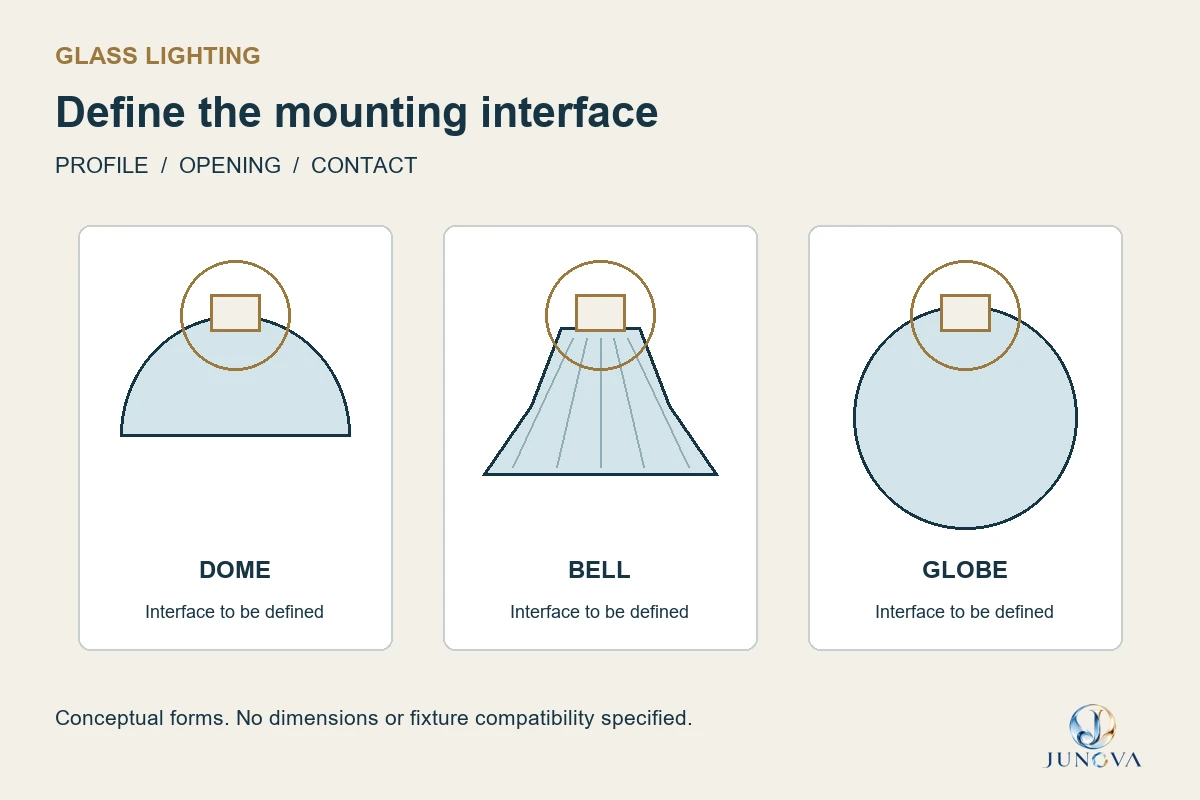
Is a nominal fitter size the actual glass measurement?
A named fitter size is not a complete interface drawing. Record the actual neck or opening, the profile and the retaining hardware separately. The shade’s widest body diameter is a different dimension and cannot establish mounting fit.
| Arrangement to identify | What the drawing needs | What one diameter cannot confirm |
|---|---|---|
| A neck or lip entering a holder | The outside profile, engagement height, receiving opening and retaining details. | Clearance, seating and the contact with screws, clips or other retainers. |
| An opening around a fixture component | The clear opening, thickness at the interface and retained/supporting surfaces. | That an apparently similar hole works with another holder or ring. |
| A project-specific connection | The glass and hardware drawings, orientation and mating surfaces. | Interchangeability with a catalogue image or a generic fitter name. |
For unit conversion, 1 inch equals 25.4 mm: a drawing dimension of 2 inches converts to 50.8 mm. That arithmetic converts a dimension; it does not select a nominal fitter or add a fit allowance. Keep the original drawing units and agreed tolerances visible.
For a complete project, return to the custom glass shade brief. Review the finish comparison separately from the mounting decision.
Which glass shade mounting arrangement do you have?
For a lipped neck, mark the lip and the point where the holder grips it. For a shade ring, mark the clear opening and the face the ring presses against. For a supported globe, mark the surface that bears its weight. Keep those features separate from the widest part of the shade.
Ask the fixture partner to name the system and show the parts that retain the glass. Useful descriptions include a lipped glass neck held by a thumbscrew holder, a plain opening used with a socket shade ring, and a neckless globe supported by a dedicated holder. These descriptions start the discussion; they do not make parts from different systems interchangeable.
The B&P lighting glass catalogue distinguishes neckless openings from other fitter forms and lists overall dimensions separately. Follow the selected component's drawing rather than treating a familiar catalogue size as a complete specification.
“Neckless” also leaves a hardware question open. Grand Brass describes one neckless globe holder with an inside plate and an outside cover. Its guidance specifies vertical orientation and a way to release the cover for bulb access. Those instructions belong to that arrangement; ask the fixture partner for the requirements of the actual holder in your project.
Where should you measure the neck, opening and body?
A nominal 2¼ in label converts to 57.15 mm. Use the conversion to read the drawing, then measure the actual glass where the holder engages. Record the measured value, the hardware reference and the supplier’s tolerance together. The conversion alone leaves those fit details open.
On a necked shade, draw the outside neck profile and any lip, step or groove that the holder engages. Mark the neck height and the surfaces involved. On a neckless shade, point to the clear opening's inside edges and show the surrounding edge thickness and profile. If there are several openings, label the mounting opening and the access opening individually.

Original measurement illustration, not a production drawing. Arrows identify features; no dimensions, tolerances, threads or hardware compatibility are specified.
Keep maximum body width and overall height on the same drawing, but label them separately from the attachment. State units beside the dimensions. If a supplier uses inches and your drawing uses millimetres, keep the original nominal designation alongside the agreed measured limits. A unit conversion alone does not define manufacturing clearance.
Use a section view where a photograph hides the contact surface. Ask the glass supplier and fixture partner to agree the measuring method and acceptable range. Do not add a universal clearance, screw torque or edge tolerance from an unrelated shade.
What should a glass shade three-view drawing show?
A useful review packet has three views: the glass on its own, the hardware on its own, and the intended assembly. Give the glass drawing a revision and identify the holder, socket cover, retaining ring or other required parts by the fixture partner's reference. In the assembly view, mark where the glass rests and where it is retained.
Ask who supplies each item. A photograph may show a metal cap or ring for context even when the quotation covers glass only. Record included parts explicitly, and identify who approves mounting orientation, access for lamp replacement and the finished luminaire's requirements. Keep these decisions separate from a colour or texture approval.
Can a catalogue photograph confirm fitter compatibility?
JUNOVA Glass's JN-015 blue dome shade, JN-016 fluted bell shade and JN-017 frosted globe glass offer different starting forms. Their current catalogue pages ask buyers to confirm the mounting opening, dimensions and supply scope. They do not publish a numeric fitter specification.
Choose the form that communicates your design, then add your fixture drawing. A globe shape does not establish a neckless mounting system; a dome photograph does not confirm that it fits a particular holder. For replacement work, include the existing hardware reference and accessible measurements as well as the original glass image.
What belongs in the mounting interface record?
Download the blank glass shade interface worksheet (CSV). It separates the glass feature, hardware reference, measuring method and approval responsibility. Fill one record for each glass-and-holder combination, including a new size that looks similar to an approved one.
Before releasing the sample, resolve three questions in that record: Which exact feature was measured? Which hardware revision was used? Who accepted the assembled result? Keep unresolved fields open rather than treating a nominal fitter name as a fit approval.
Explore the lighting glass collection or discuss a drawing through custom glass development. Send the selected form, mounting views, hardware reference, quantity and destination market so the scope can be reviewed together.
Continue your lighting glass brief
For a project enquiry, send the glass and mounting drawings, finish, sample scope, quantity and destination.
Compare glass shade references