
In this guide
To describe candle jar shipping weight, record what is inside the carton, weigh the sealed package and measure its outside dimensions. Product net weight, carton gross weight and dimensional weight answer different questions. A glass jar's capacity in ounces cannot stand in for any of them.
This guide is for buyers arranging samples or cartons of empty candle vessels. It provides a packing-data method, not a freight quotation. JUNOVA Glass's JN-CJ001 cylindrical candle jars are the product reference; the arithmetic below uses invented weights and cartons rather than unpublished product specifications.
In this guide
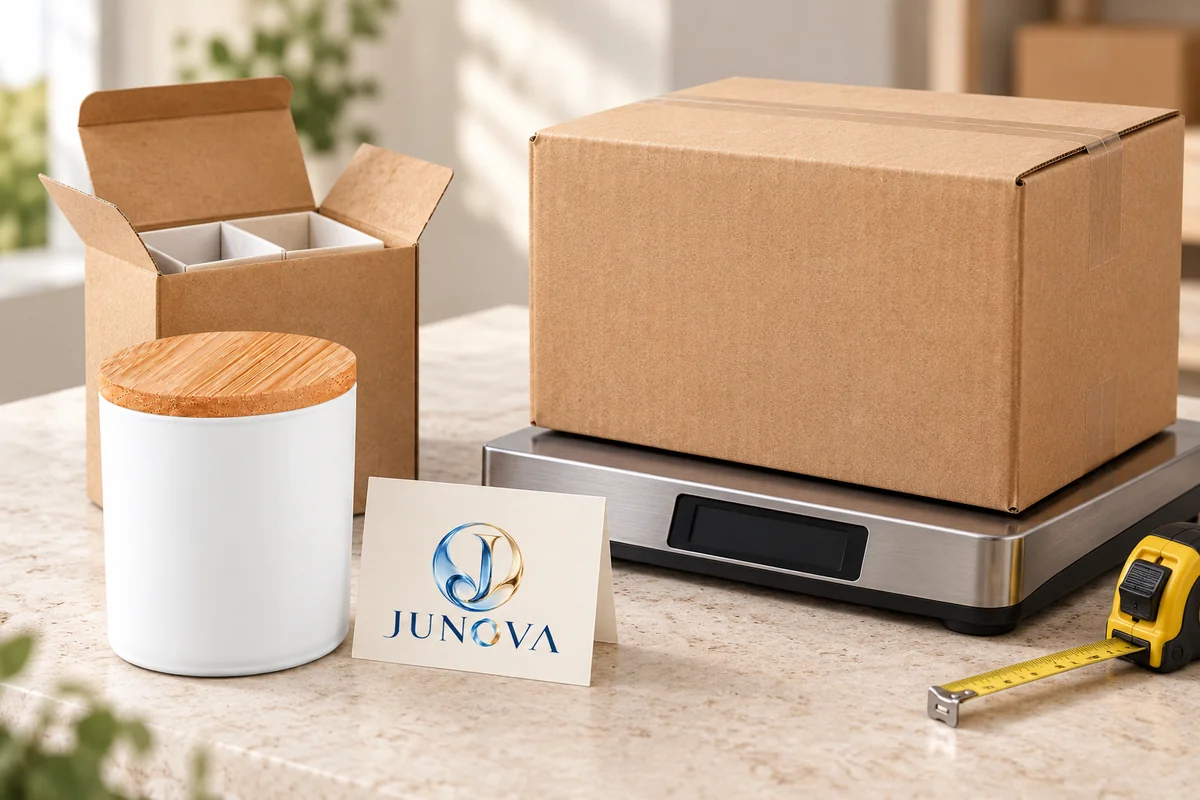
How do you calculate the gross weight of a candle jar carton?
Multiply the mass of one complete unit by the number of units, then add all packing assigned to that carton. Define whether the unit already includes its lid and retail box so that the same component is not counted twice.
Carton gross mass check
Use actual component masses and a whole-number packing quantity.
Method: Gross carton mass (kg) = unit mass (kg) × unit count + additional packing mass (kg).
This is a mass reconciliation, not a freight price or chargeable-weight estimate. Dimensional weight uses the actual carton dimensions and the divisor for the selected carrier/service; compare those terms separately.
When requesting freight, send the outside carton dimensions, carton count, gross weight per packing variant, destination and the intended shipping arrangement. The insert fit record should identify the same packed unit.
What is included in the unit being weighed?
Start with the scope of the product measurement. “One jar” might mean bare glass, glass with its lid, or an individually boxed set. Write the included components beside the weight. If the lid is supplied separately, give it a separate reference and quantity.
| Field | What the record describes |
|---|---|
| Unit product mass | The identified glass item and any expressly included product components |
| Carton product net mass | The sum of the defined product units inside one carton, excluding its packing |
| Actual carton gross mass | The sealed carton and everything it contains, including boxes, dividers and protection |
| Dimensional weight | A carrier calculation from package dimensions and the applicable divisor |
A retail box can be part of an individually packed unit or a separate packing input in your working sheet. Choose one convention and name it, so it is not omitted or counted twice. For customs or transport documents, use the definitions and fields required by the responsible shipping team.
The JN-CJ001 page offers several reference sizes and lid choices. Those choices need separate measured packing records where they change the unit or carton. The page does not publish a verified jar weight or a fixed carton quantity. Do not derive mass from its outside diameter and height.
How do you reconcile unit and packing mass?
Consider an invented record for 24 empty jar-and-lid sets. Assume each complete set weighs 0.35 kg. Their combined product mass is 24 × 0.35 = 8.40 kg. If all packing for that carton weighs 1.20 kg, the expected gross mass is 8.40 + 1.20 = 9.60 kg.
These numbers explain the arithmetic. They are not JN-CJ001 weights, a recommended packing count or evidence that a particular carton protects glass. In a real record, compare the calculated total with the measured sealed-carton mass. If they disagree, check the unit count, lid scope, packing list, units and scale record before sending the data onward.
A sample carton with spare lids or mixed sizes needs its own line. Multiplying one full-carton figure by the order quantity can miss a partial carton or a different pack configuration. Keep empty glass separate from a filled candle; for the fill specification, refer to the capacity and wax-weight guide.
How do gross and dimensional weight differ?
DHL Express's dimensional-weight explanation uses outside package dimensions and describes comparing dimensional weight with actual weight. Its Singapore guidance shows a divisor of 5000 for centimetres and kilograms, while advising shippers to confirm the applicable divisor with their carrier.
Using that divisor for this illustration: dimensional weight in kg = outside length in cm × width in cm × height in cm ÷ 5000. The following two hypothetical cartons are both assumed to have an actual gross mass of 9.60 kg, solely to show the effect of changing volume.

Original arithmetic illustration. All weights and carton sizes are hypothetical. Real changes to a box or protection material require a new measurement.
Carton A gives 40 × 30 × 30 ÷ 5000 = 7.20 kg; carton B gives 50 × 40 × 40 ÷ 5000 = 16.00 kg. Comparing each with its assumed 9.60 kg actual gross mass selects 9.60 kg for A and 16.00 kg for B, before any service-specific rounding or other rating rules.
Confirm those rules for the selected service and route. Do not apply this express-parcel example unchanged to a pallet, sea shipment or another service. UPS's shipment-detail guidance likewise asks for actual package weight and dimensions. An accurately measured jar alone is not a complete parcel record.
What changes between carton packing variants?
Download the blank candle jar carton data sheet (CSV). It keeps the product-and-lid reference, units per carton, measured mass, closed outside dimensions, packing revision and shipping-service assumptions together. Example weights are deliberately not prefilled as approved specifications.
Retain a carton ID and the date of measurement with the packing photographs. When the lid, inner box, quantity or protection changes, identify the affected record and remeasure the finished carton. For an order with several pack types, send a separate row for each type and the number of cartons using it.
Keep packaging protection as its own review. The gift-box insert guide covers support and removal fit; a weight comparison does not validate transport protection. Browse candle and fragrance glass or use custom glass development to discuss the selected vessel, lid and packing scope before finalizing shipment data.
Continue your candle packaging brief
For a project enquiry, send the selected jar, target fill, lid, finish, quantity and destination.
Compare glass candle jars