
In this guide
Choose the usable opening around the arrangement you want to make. A narrow mouth can help position a single stem or a few stems; a bouquet needs enough clearance to enter without being forced and enough room to keep its intended spread. The widest part of a vase is not the opening. Shortlist the profile, then try the intended arrangement in the actual sample.
For a florist, homeware collection or hospitality project, “small vase” and “large vase” leave too much unresolved. Two vessels of similar height can behave differently because one has a restricted neck and the other opens directly into the body. This guide separates those choices and gives the buyer and florist one record for comparing them.
In this guide
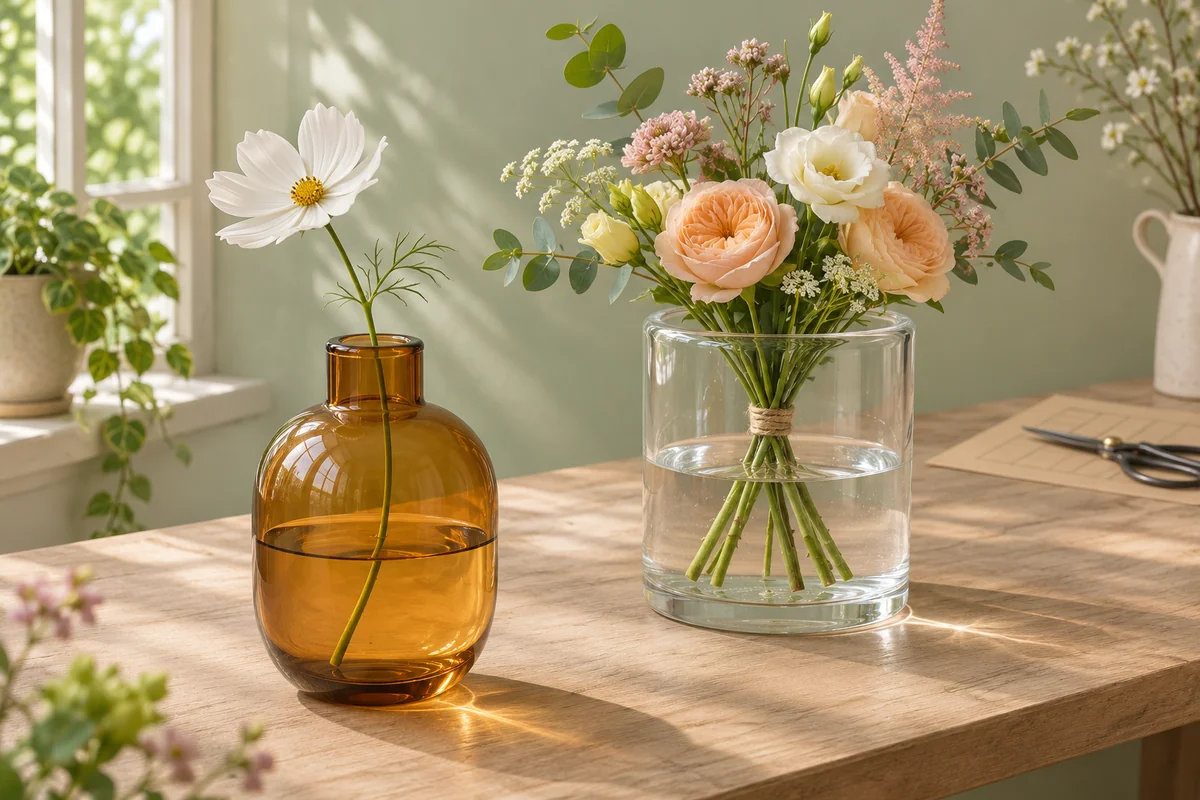
Is the vase opening the same as its widest diameter?
No. The usable opening, neck profile and widest body are different measurements. The opening affects how stems enter and spread; the body and neck affect how the arrangement sits inside the selected vessel.
Compare two identified vase samples with the same intended stems or bouquet. Record where the opening is measured and photograph the complete arrangement. A flower count alone is not enough to prescribe one universal mouth diameter.
What arrangement should the vase opening support?
Describe how the stems should sit before choosing an outside shape. Interflora’s vase guide explains the practical trade-off: an opening that is too wide may offer too little support, while one that is too narrow may constrain the bouquet. IKEA’s flower-and-vase guide also distinguishes a supported single stem from a bound bouquet that needs space inside. These are useful starting principles; neither supplies a specification for the particular vase you are buying.
| Intended arrangement | What the opening needs to do | What to check on the sample |
|---|---|---|
| A single stem or a small, loose grouping | Help locate the stems without closing around them. | Whether they lean where intended, and whether the neck allows insertion and removal without forcing. |
| A prepared, tied bouquet | Admit the bundle at its widest point that must pass through the mouth. | Whether the bundle enters intact and sits at the intended depth; a tie or crossed stems may need more room than the cut ends. |
| An open, spreading arrangement | Allow the desired stem angles and spread. | Whether stems slide apart or fall to one side. If the design uses a support grid or another florist’s aid, include that exact aid in the trial. |
There is no dependable stem-count label based on mouth diameter alone. Stem thickness, foliage, the tie point and the desired angles all change the fit. Agree the floral reference rather than describing an untested vase as a “ten-stem vase.” Likewise, use a height ratio as a styling idea, not a pass/fail rule for every flower or placement.
Where do you measure the usable vase opening?
Record three separate dimensions: A, the clear inner opening; B, the widest outer body; and H, the overall height. A describes the space available at the mouth. B helps describe the object’s footprint and visual volume. H describes the vessel, not the finished arrangement. Use one agreed unit and identify the measurement points on a drawing or photograph.

A flared lip can hide a narrower passage below it. Check the smallest restriction the stems must pass, not only the apparent width at the top edge. On an oval or irregular mouth, mark the relevant clear spans and the orientation instead of reducing the opening to one outside diameter. The florist also needs to know whether stems have room to spread once inside.
Access matters after arranging too. Discuss how water will be added or changed and how the interior will be cleaned. A narrow entrance may limit access even when the arrangement looks right. If the collection will hold water, specify that intended use and agree an appropriate check on the selected construction; a decorative photograph does not establish water tightness.
How do you compare two vase profiles with the same stems?
For example, a hotel buyer might shortlist a compact vase for individual guest tables and a broader form for a lobby bouquet. These are two different floral briefs. First compare candidate vases within each brief, rather than judging both with an unrelated arrangement.
Ask the florist to use the same intended stems, tie method and support aids in the candidates being compared. Note any trimming or rearranging needed to make a candidate work. Otherwise a successful photograph can conceal a change in the floral design.
- Enter: observe whether the bundle passes the mouth and any neck restriction without forcing or catching.
- Place: note the depth, stem angles and spread. Record whether the arrangement needs an additional support aid.
- View and service: inspect the finished composition in its intended position, then review access for the planned water change and cleaning method.
Download the blank vase arrangement fit record (CSV). It provides one row per candidate, with fields for A/B/H, the narrowest passage, floral reference, insertion, spread, access and the decision still open. The observation fields are blank: this is a comparison aid, not a claim that JUNOVA Glass has tested an arrangement.
For tables, include the surrounding setting and sightlines in the review. For a tall or projecting arrangement, check the complete sample in the intended placement and agree the applicable stability assessment. Neither a heavy-looking base nor a large body width establishes resistance to tipping.
What should you send for a glass vase arrangement brief?
JUNOVA Glass’s amber facet vase, JN-007, is a reference for a faceted amber silhouette. The colour petal vase, JN-010, offers a different decorative direction. Their current pages identify them for interior display and decorative collections and leave numeric dimensions to the agreed drawing and sample. The names and styling images do not establish which bouquet fits, or whether a proposed wet-floral use is suitable.
Browse the decorative glass collection to choose a visual reference, then send the intended arrangement, usable-opening requirement and placement through custom glass development. Include whether the brief is for dry stems or water-filled use. For the separate task of recording revisions and sign-off, use the existing glass sample approval guide.
Continue your decorative glass brief
For a project enquiry, send the selected profile, opening measurements, arrangement brief, quantity and destination.
Explore decorative glass referencesIf your project also includes display objects, use our decorative glass gift guide to compare shelf views, clearance, and boxed presentation.